Monday, 17 September 2012

Author celebrates launch of History, heritage and tradition in contemporary British politics

Emily Robinson was joined by a host of eminent figures, including Jon Cruddas MP and Prof. Patrick Wright, to launch her new title History, heritageand tradition in contemporary British politics at The House of Lords last week.

Both Jon Cruddas MP and Prof. Patrick Wright (Kings College London) gave speeches to mark the launch of this groundbreaking title, while Mary Riddell from the Daily Telegraph acted as an excellent chair to proceedings.

We’re also grateful to The Primrose Hill Bookshop, who set up a bookstand at the event selling copies of the book to guests.

Mary Riddell chairs the launch

Prof Patrick Wright speaks to the gathered audience


Jon Cruddas MP and author Emily Robinson

Emily Robinson speaking at the launch

Guests gathering at the The House of Lords


Tuesday, 11 September 2012

Rachelle H. Saltzman's 'A lark for the sake of their country' wins prestigious US prize


The History and Folklore Section of the American Folklore Society announced recipients of the Wayland D. Hand Prize for an outstanding book published between June 2010 and June 2012 that combines historical and folkloristic perspectives. The prize established in 2004 honors the eminent folklorist and historian Wayland D. Hand (1907-1986), who in his teaching and scholarship encouraged historical methodology in folklore research.

Although the custom of bestowing the prize has been to have a single winner, the evaluation committee felt that among the many submissions this year, two books deserved equal merit. This is the second time the committee has co-recipients of the prize. The committee recommended sharing the prize between the following two authors because they produced different forms of work integrating historical and folkloristic perspectives in an appealing and sophisticated way. The committee also lauds the presses publishing these works—Princeton University Press and Manchester University Press--for superior production and design quality and impressive packaging of these books. The joint recipients are:

Jack Zipes, The Irresistible Fairy Tale: The Cultural and Social History of a Genre.  Princeton and Oxford: Princeton University Press, 2012.

Rachelle Hope Saltzman, A Lark for the Sake of Their Country: The 1926 General Strike Volunteers in Folklore and Memory. Manchester and New York: Manchester University Press, 2012.

Rachelle Hope Saltzman draws an array of important ramifications for the understanding of British identity, collective memory, and cultural formation from a specific event—the 1926 General Strike from May 3 to May 12 called by the council of the Trades Union Congress in an unsuccessful attempt to force the British government to prevent wage reduction and improve working conditions for coal miners.  She finds significance in folk cultural displays—including pranks, dress, festivity, and jokes-- of over half a million registered volunteers in support of the strikers.  Judges found convincing her use of this evidence as central features of the rising group’s communication and creation of symbols that would have a lasting effect on British self-consciousness. Also praiseworthy in the judges’ view is the author’s integration of multiple methodologies including oral history, ethnographic analysis, rhetorical criticism, and social evaluation to offer a cohesive and persuasive argument for the symbol-building functions of historical events that groups embrace to achieve a cooperative society out of conflict.


The next Wayland Hand Prize competition is scheduled for July 2014.

Thursday, 6 September 2012

Ethnography symposia plays host to the launch of An ethnography of English football fans

By Geoff Pearson

The launch date for An Ethnography of Football Fans: Cans, Cops and Carnivals coincided with the 7th Annual Ethnography Symposium held at the University of Liverpool’s Management School 29-31 August. Organised by the Ethnography at Liverpool and Keele group, the symposium is a cross-discipline forum for ethnographers from all over the world. The 2012 symposium’s title was Ethnographic Horizons in Times of Turbulence and attracted around 100 delegates and 60 papers, with keynotes delivered by Karen Ho, Simon Down, John Weeks and Gideon Kunda. The symposium finished with a lively debate on the topic of conducting ethnography in the age of ethical approval: a panel session involving Heather Hopfl, John van Maanen and representatives of Liverpool University’s Ethics Committee. The 2013 Symposium will take place in Amsterdam in August, and more details can be found here.


The book launch itself gave the series editor Dr Alex Smith an opportunity to showcase the New Ethnographies series and attracted considerable interest from the delegates in terms of both existing publications and potential new projects. Dr Smith commented,

‘It was a pleasure to meet so many scholars engaged with ethnographic research and the interest of Symposium delegates in our books was very encouraging. The feedback on our series was superb: everyone was delighted to learn of Manchester’s renewed commitment to ethnographic publishing in a challenging climate for academic publishing.'

It was also fantastic to see one of my research participants attending; one of my beliefs about ethnography is that it is important to make our work as accessible as possible to those we are researching as this is an important way to demonstrate authenticity and accuracy. Dr Smith believes the New Ethnographies series will encourage further quality research in this field,

‘Ethnography is capable of attracting academics across a wide variety of disciplines. It is now clear that the ‘New Ethnographies’ series is well placed to promote interdisciplinary debate on ethnographic methods, both here in the UK and abroad. We look forward to engaging further with scholars and students through the Ethnography Symposium as we continue to solicit and publish some of the very best new ethnographic monographs. We also welcome the support of all those who are passionate about ethnography in helping us establish our book series as one of the world’s leading lists in publishing innovative and original ethnographic research.’

While An Ethnography of Football Fans obviously has to be written in a style that contributes in a meaningful way to the academic understanding of football fan behaviour (as well as engaging in debate about the principles and value of ethnography), I have tried to keep it as accessible as possible, and a number of my former research participants have already read all or part of the book. So far the feedback from them has been positive!

MUP blog readers can take advantage of a special 15% discount on all titles in the New Ethnographies series. Simply contact our distributors on +44 (0)1752 202301, or email your details to orders@nbninternational.com, quoting the discount code OTH306 (offer expires 31/10/2012).

Visit our website for a full list of titles in the New Ethnographies series. Highlights include,


The British in Rural France: Lifestyle migration and the ongoing quest for a better way of life


Devolution and the Scottish Conservatives: Banal activism, electioneering and the politics of irrelevance
                 
Chagos Islanders in Mauritius and the UK: Forced displacement and onward migration


Monday, 3 September 2012

The varieties of Enlightenment

Pope Benedict XVI, Jürgen Habermas, and
the ‘cognitive substance’ of religion
 
 
The period known as ‘The Enlightenment’ is usually taken to have ushered in an intensely secular phase of modernity, in which faith in religion was displaced by a naturalistic, scientific approach to life and living.

However, whereas latter day proponents of Enlightenment, such as Richard Dawkins, tend to place science and reason on one side against religious faith and authority on the other, such an opposition was not one shared by many of the key Enlightenment thinkers. One need only mention the deism of the likes of Voltaire and Jefferson. Rather than an attack on religious faith, Enlightenment thinkers tended more towards a questioning of religious authority. A key element of deist thinking was that God could be known by rational, and perhaps even scientific, means. Voltaire was adamant in his denunciation of religious authority, but advocated a rationally justified belief in God.

What the Enlightenment insisted on was not so much scientific materialism — although this tendency was very much present in thinkers such as La Mettrie — but rather on the public presentation of good reasons for any belief whatsoever whether that of church, science, state, or tradition.

It is the materialist, mechanistic strand of Enlightenment thinking that has drawn the greatest fire but also the most passionate support. However, simply to divide the legacy of the Enlightenment into a materialist, scientific rationalism on the one hand, as opposed to a religious obscurantism on the other is to ignore the varieties of Enlightenment thinking that not only existed historically but which still promise a creative engagement between science, reason, and religion.

The Enlightenment project of scientific, universal rationality has also had its fair share of non-religious critics. Theodore Adorno and Herbert Marcuse, of Frankfurt school fame, argued, variously, that science was a form of instrumental (or means-ends) rationality that had its roots in the philosophy of Francis Bacon. For Bacon, the acquisition of knowledge about the natural order was intimately connected to increasing our power to control nature — nature’s secrets were to be wrested from it in order that we might make it our servant. Their charge against the Enlightenment was that it brought about a new historical form of scientific social domination. Once human beings were seen as the creations of nature alone then a Baconian imperative of domination through scientific knowledge would follow. Furthermore, economic life became the domain in which the domination of scientific rationality was realised and justified: human-beings became enmeshed in a system of things in which they also became a thing.

The Frankfurt school philosopher Jürgen Habermas has attempted to develop the anti-authoritarian social and political role of reason, inherited from Enlightenment thought, whilst overcoming the instrumental use of science as a means of dominating human-beings. As an advocate of rational secular interests, it is significant then that Habermas has recently engaged with Pope Benedict XVI in dialogue — they are the co-authors of short book titled ‘The Dialectics of Secularization: On Reason and Religion’. For Habermas, not only is a rapproachment between rationality and religion feasible, but furthermore he uses the evocative phrase ‘the cognitive substance of religion is not yet exhausted’.

Whilst Habermas argues that the constitutional basis of the state must be grounded in public, secular processes of rational deliberation, he also argues that,

When secularized citizens act in their role as citizens of the state, they must not deny in principle that religious images of the world have the potential to express truth. Nor must they refuse their believing fellow citizens the right to make contributions in a religious language to public debates.

It seems that Habermas and Pope Benedict XVI are seeking, through such public dialogue, to find a way beyond the increasingly stagnant debates between scientific, materialist conceptions of reason and those of faith that are offered without rational warrant.

 But what of the ‘cognitive substance’ of which Habermas speaks?

One might suggest that the cognitive substance of religion is expressed through, at least, three aspects: the ethical, the intangible value of religious signs, and the concept of God — this latter without reference, necessarily, to arguments about whether God exists or not. Given that the ethical is a well-trodden path in both secular and religious contexts, let's concentrate on these other two aspects.

The intangible value of religious signs. Whereas it is easy to see the value of tangible things such as everyday objects, it is much harder to understand the value of intangible signs such as images, words, and rituals. One might say that whereas the value of tangible things may be exhausted — the value of food is exhausted once it is eaten and digested — the value of certain intangible signs appears to increase the more they are used, and seems to be inexhaustible.

Religious imagery is an example of inexhaustible, intangible value. Think of the image of the risen Christ from Grünewald's Isenheim alterpiece. The exact meaning of this image is hard to pin down. However, in attempting to grasp its meaning it continues to evoke not only further thought but also a sense of the numinous. It stimulates cognitive effort whilst also shaping that effort — but we are never done with it.

The cloaking of religious thought and experience in artistic form tells us a great deal about the particularity of religions and their cultural background. In practice, religious images, words, and rituals are interwoven with other aspects of cultural life – think, for example, of the great many people who carry and use rosary beads. It is the particularity of religious images, such as Grünewald’s, that provoke the mental effort that in turn generates cognitive value or substance. In attempting to make this value explicit we are in the realm both of reason (cognition) and religion (the numinous).

The concept of God. A great deal of effort has been expended by both religious and non-religious thinkers to determine whether we ought to believe that God exists or not. The question of whether there is evidence or not for the existence of God, what might constitute such evidence, whether this is a matter of faith, or rational inquiry, or is open to scientific investigation, are all questions that have been deeply debated. However, one might consider the concept of God in distinction to the question of whether God does or does not exist. That is, not as a matter of faith or belief, but rather as a wider question concerning concept acquisition and use.

In thinking about God, one also thinks about a great many other things. One might ask, for example, what God would have to be like in order to possess powers such as omniscience or omnipotence. But then one must conceptualise the nature of omniscience. What does omniscience actually entail? And if such a power is available to God, how does God know all things at once? Further questions such as the relation between time, knowing and causation immediately arise. The theologians of old asked such questions within a faith-based context. However, if we bring both philosophical and scientific reasoning to our questions, we may then think about our concepts of knowledge and time, and so on, relative to our concept of God. We do not have to believe in God as such, to find the deployment of the concept of God of great cognitive value.

Following such a conceptualist approach, reason, science, and religion are taken then to be complementary aspects of a broader search for Enlightenment. Pope Benedict XVI and Jürgen Habermas seem to propose that such a variety of Enlightenment thinking has an intellectual force and a cultural value that is consonant with both religious and secular interests. The cognitive substance of religion is not yet exhausted because reason is still not done with it.

Shivdeep Singh Grewal is the author of Habermas and European integration, which was recently published by Manchester University Press. Until the end of October 2012, MUP blog readers can purchase a copy of Grewal's title with at a special 15% discount.  Simply contact our distributors on +44 (0)1752 202301, or orders@nbninternational.com, quoting the discount code OTH304.
 

Thursday, 30 August 2012

Writing on JG Ballard


By Shivdeep Singh Grewal


Back in 2009, I was at work on the final draft of Habermas and European integration, my recently published book. The fate of the eurozone was already by then a cause for concern.
I had chosen from the book’s conception to focus on the ‘lifeworld’, the concept in terms of which German philosopher Jürgen Habermas has discussed the sphere of everyday experience. This qualitative orientation led me to a slightly different take on Europe’s burgeoning crisis to those of either political science or economics. So, too, did engagement with literary and philosophical works, a feature of Habermas’s essays. In at least two ways, then, Habermas’s work helped me to understand and to write about the ‘cultural pessimism’ and ‘morbidity symptoms’ (to borrow terms from Thomas McCarthy and Philippe Schmitter, respectively) that have characterised European politics in the wake of 9/11; building on Habermas’s insights, I have come to situate phenomena as different as the Constitutional Convention and the assassination of Pim Fortuyn within a single overarching theoretical framework.

Among the literary works referenced in Habermas and European integration are those of English novelist J.G. Ballard. I was struck by his sensitivity to the complexities — and attendant morbidity symptoms — of contemporary European life. My interest in Ballard and others such as Michel Houellebecq grew until I was persuaded to devote an appendix to these ‘writers of social science’. I had a vague intention of one day developing a method of research informed by their ideas — the article below may be thought of as an effort in that direction. Writing it for a local newspaper in 2009 offered an alternative to the strictures of scholarly publication. It also gave me a new, and quite different, audience for my research.

In writing for such a publication, I was following in Ballard’s footsteps. He too had broached philosophical themes where perhaps this would not have been expected. During his tenure with the trade journal Chemistry and Industry, for example, Ballard once devoted an editorial to Goethe’s philosophy of science.
 
____________________________________________________

J.G. Ballard is usually associated with Empire of the Sun, his best-selling novel. Set in Shanghai during World War II, it was the subject of a Hollywood adaptation by Steven Spielberg. It may surprise some, then, that Crash, another of Ballard’s well-known titles, is set closer to home — some of the action occurs in Northolt.
I’ve been studying Ballard’s work as part of the research for a book that I’m writing. But I’m also a lifelong Ealing resident, with memories of Wednesday morning swimming lessons at Northolt baths, so my interest is personal as well as academic. I thought I’d try and find the Northolt of Ballard’s imagination, the places that inspired him. Perhaps they’d shed light on the man and his work.
I began with the westerly stretch of the A40, before it turns to motorway. My first awareness of it came in 1977, during an assembly at Oldfield First School. The headmistress introduced a man from the council. Gesturing at diagrams, he spoke of a ‘flyover’ that would one day carry traffic over the junction with Greenford Road. It appeared a couple of years later. In retrospect, it could almost have been designed by Ballard himself, a quicker route to Northolt for his restless characters.

We’re well used to the flyover now. In fact, it’s hard to convey the interest this sort of development would have generated back then. That’s the era Ballard chronicles in Crash, when motorway travel was emblematic of the future, almost the stuff of science fiction. Though not the most scenic of walks, it's possible to get to Northolt from the flyover by following the A40. That was the path I chose.  Earlier, I’d Googled ‘Ballard’ and ‘Northolt’ but turned up little in the way of new information. I thought the locals might have answers. My questions raised eyebrows.
Finally, outside Northolt tube station, a kindly attendant agreed to help. Though no longer a resident, he’d grown up in the area. I asked him of the 1970s. Had there, as suggested in Crash, been stock car races in ‘Northolt Stadium’? He was emphatic on this point: there had been neither a stadium nor stock cars, though, come to think of it, there had once been a pony track nearby (it opened in 1929, the year of the Wall Street Crash). Could it have hosted the occasional stock car race? Again, he shook his head: it had been closed since before the war. However, it left its mark. For the streets of a nearby estate bore the names of famous racing venues.
What of ‘Northolt General Hospital’? Was this real? Apparently not, another of Ballard’s fictions. And the multi-storey car park that features again and again in the pages of Crash? The station attendant laughed: there had never been room for Northolt’s own beleaguered motorists, he told me, let alone visitors from out of town! I had more luck with my final question. He said there had once been a police station nearby, and that there had probably been a car pound attached to it of the sort mentioned in Crash.
I’d turned up some interesting leads, though these weren’t conclusive. I knew from previous research projects that more interviews would have to be conducted before an image from the past stood before me, the Northolt that Ballard had seen.

© Shivdeep Singh Grewal (2012)

Friday, 24 August 2012

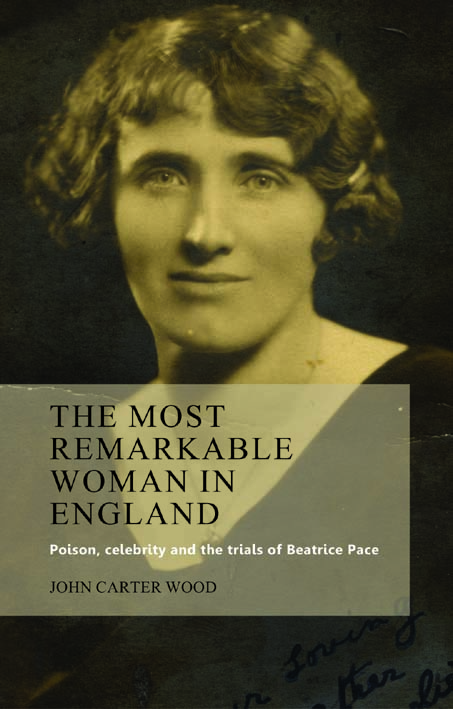
An introduction to 'The most remarkable woman in England'

In the summer of 1928 the trial of Beatrice Pace sparked spectacular press coverage, heated parliamentary debate and intense public emotion. On 31 August, we release the first book on this now-forgotten episode from the golden age of press sensations.

On 6 July 1928, Beatrice Pace left the Gloucester Shire Hall a free woman after being acquitted of the arsenic murder of her husband. She was met not only by a boisterous crowd of thousands of well-wishers but also by flocks of reporters who brought her trial—‘one of the most amazing within living memory’ (News of the World)—to the next morning’s front-pages. 

But her acquittal is only the beginning of the story. Pace sold the rights to her ‘tragic’ life-story to the Sunday Express, and her treatment by the police and justice system was debated in the press and in Parliament. Tourists converged on her isolated home. Men wrote to propose marriage. Now forgotten, Beatrice Pace was a household name in 1928, and her case was a touchstone for discussions about domestic violence, civil liberties and the plight of poor people accused of serious crimes.

Drawing on extensive and original research, this book, for the first time, recalls this hidden chapter in the annals of British crime, telling Pace’s story and placing it within the fascinating context of inter-war culture, media, law and politics. It spans settings from a lonely cottage in the Forest of Dean to the House of Commons and sources ranging from meticulous detectives’ reports to heartfelt admirers’ letters.

It also speaks to issues of enduring interest. The public still finds heroes and villains in stories of crime and murder, imagining close connections to strangers known only through the media. The astounding letters Pace received allow a rare insight into the reactions of press readers.

Historian John Carter Wood uses such vivid sources to reconstruct the unforgettable story of the person the Sunday Express dubbed ‘the most remarkable woman in England’.

Author John Carter Wood says:
‘When I first stumbled across this case, it was clear to me that it not only provided important historical insights but was also a story full of mystery, colourful personalities and personal drama. From that beginning, I aimed to write a book that would appeal to historians of crime, media gender and inter-war culture as well as anyone interested in the extraordinary lives of ordinary people.’

The book will be available from 31 August 2012 (US and Canada 2 October).

To find out more about 'The most remarkable woman in England' visit http://pacecase.blogspot.co.uk and www.manchesteruniversitypress.co.uk

Thursday, 2 August 2012

Authors celebrate the launch of Coercive confinement in post-independence Ireland

During the first fifty years of Irish independence, tens of thousands of men, women and children were incarcerated. Psychiatric hospitals, mother and baby homes, Magdalen homes, reformatory and industrial schools and prisons formed a network of institutions that was integral to the emerging state.

A unique new book by Eoin O’Sullivan (Trinity College Dublin) and Ian O’Donnell (UCD Institute of Criminology) provides a wealth of contemporaneous accounts of what life was like within these austere and forbidding places, as well as offering a compelling explanation for the longevity of the system and the reasons for its ultimate decline.

While many accounts exist of individual institutions and the factors associated with their operation, Coercive Confinement in Ireland: Patients, Prisoners and Penitents, is the first attempt to provide an overview of the interlocking range of institutions that dominated the physical landscape and, in many ways, underpinned the rural economy.

Launching the book in the UCD Global Lounge during the 8th Irish Criminology Conference, Mr Justice Sean Ryan observed that:

“This book is valuable as a synthesising analysis, a fascinating collection of contemporary material and even more as a road map for future exploration of the territory of official and semi-official modes of detention.”

Address by Mr Justice Sean Ryan

Thanking Mr Justice Ryan, Professor O’Donnell noted that one of the key themes addressed in the book was the extent to which a high level of incarceration went unchallenged despite the many associated harms.
Eoin O’Sullivan (TCD), Mr Justice Sean Ryan and Ian O’Donnell (UCD)

He expressed the hope that the critical mass of informed criminal justice researchers and commentators that is emerging in Ireland would help to ensure that silence, complacency and looking the other way were consigned to the past, especially where vulnerable citizens were concerned.


Eoin O’Sullivan is Head of the School of Social Work and Social Policy at Trinity College Dublin.

Ian O’Donnell is Professor of Criminology at University College Dublin.

Thursday, 26 July 2012

Timed out available in Barbados

Timed Out, by Leon Wainwright, is now available in Barbados through Fresh Milk, an artist led initiative.  Fresh Milk offers an informal platform for exchanges among contemporary practitioners/thinkers/writers/makers.

For more details, and to contact the Fresh Milk team directly, visit their Facebook page.

More information about Timed Out can be found here.

Tuesday, 24 July 2012

MANCHESTER UNIVERSITY PRESS LAUNCHES MANCHESTER SCHOLARSHIP ONLINE TO MAKE SCHOLARLY MONOGRAPH CONTENT AVAILABLE VIA THE UPSO PLATFORM

Manchester University Press is pleased to announce it has partnered with Oxford University Press to launch Manchester Scholarship Online (MSO) on OUP’s University Press Scholarship Online (UPSO) platform taking advantage of a fully enabled XML environment with the cutting edge search and discovery functionality. Manchester Scholarship Online will provide instant and comprehensive access to the full text of nearly 300 titles of the highest academic quality in 5 subject areas – History; Literature; Political Science; Film; Television and Radio and Society and Culture.

"We are excited to be part of UPSO. Our titles represent the best of new research in the Humanities and Social Sciences and UPSO offers a suitably high-quality platform for our books. We are very pleased that there is such a technologically advanced, well-realised solution to make our content available to scholars all over the world and it's great that our Manchester brand will be so clearly identified with such an excellent platform."
David Rodgers, Chief Executive, Manchester University Press

Responding to increased demand for online scholarly content, UPSO streamlines the research process by making disparately published monographs easily accessible, highly discoverable and fully cross-searchable via one online platform. Research that previously would have required users to jump between a variety of books, and disconnected websites can now be concentrated through a single search engine. 

Manchester Scholarship Online provides an online hub for the best in Manchester University Press monographs while also providing users with the latest set of highly intuitive tools to enable deep search across all the content in the UPSO program. As such, UPSO will be the premier online research tool—for scholars, teachers, graduate and undergraduate students—and an essential resource for all academic libraries.

 Benefits of UPSO for academics, libraries, and partner presses:

·         Provides the highest quality scholarly content across 22 subject areas
·         Includes a vast and growing number of titles 7000+ titles will be available at launch, 652 of which are new titles, with abstracts and keywords at both the book and chapter level for each title
·         All UPSO content is available in XML, which provides deep tagging and better search results. Content can also be saved downloaded to PDF
·         Is fully cross-referenced and cross-searchable, with clickable citations from bibliographies and footnotes, including OpenURL and DOI-linking support
·         Allows users to streamline research through a single online platform
·         Can be easily integrated into library systems and updated frequently with new content
·         Offers full customer support services as well as flexibility and choice in purchasing models
·         Mobile functionality will be available later this year
·         Increase discoverability and usage of university press scholarly materials
·         Offers university presses unique opportunity to create an XML digital workflow and join a highly successful online scholarship platform, reaching the global academic market at low distribution costs

Niko Pfund, President of OUP, Inc., said, “We at OUP are delighted to welcome Manchester University Press to the UPSO fold.  A dynamic publisher across a range of social science and humanities disciplines, Manchester has developed a list of distinction and flair in recent years and we’re pleased to be assisting the press in reaching its many potential readers around the world.”

Manchester University Press

Manchester Scholarship Online
Manchester University Press is one of the largest University Presses in the UK and publishes high quality monographs, textbooks, and journals by leading scholars from around the world for use by academics and students in higher education, as well as the more general audience.

**Ends**

To speak to Manchester University Press contact:
Bethan Hirst | bethan.hirst@manchester.ac.uk | +44 (0)161 275 7746

Wednesday, 18 July 2012

New Kindle ebooks now available

A new batch of Kindle ebooks is now available to download from the Kindle store. In less than 60 seconds, you could have access to any of the following titles,

  • Adapting philosophy: Jean Baudrillard and The Matrix Trilogy
  • Beginning Postcolonialism
  • Beginning realism
  • British Asian fiction: twenty-first-century voices
  • Cultures of Violence: Racial violence and the origins of segregation in South Africa and the American South
  • Historiography: An introduction
  • History and Memory
  • The Malleus Maleficarum
  • No other way to tell it: Docudrama on Film and Television

New titles will be added to this list over the coming months. Follow us on twitter @ManchesterUP, to receive announcements every time a title is added to the Kindle store.